
About Us

Welcome to the Model-free Autonomous Agent and Intelligent Control (MAgIC) Lab at ShanghaiTech University. Our research spans the development of bio-inspired underwater and aerial robots—such as robotic fish and flapping-wing vehicles—with a focus on perception, planning, control, and multi-agent coordination. Currently, the core of our work lies at advanced motion control for robotic systems operating in dynamic fluid environments.

Underlying these applications is our fundamental research into the modeling and control of complex, nonlinear, time-varying systems across multiple scales. We develop adaptive, data-driven, and learning-based control theories with provable guarantees, tackling challenges such as uncertainty, disturbance, and system constraints.

Led by Prof. Yang Wang, our team consists of passionate PhD and master students dedicated to pushing the boundaries of fluidic-interactive robotic systems and intelligent control theory. We welcome collaborations and discussions with researchers who share our interests.

News

ICRA

31 Jan 2026

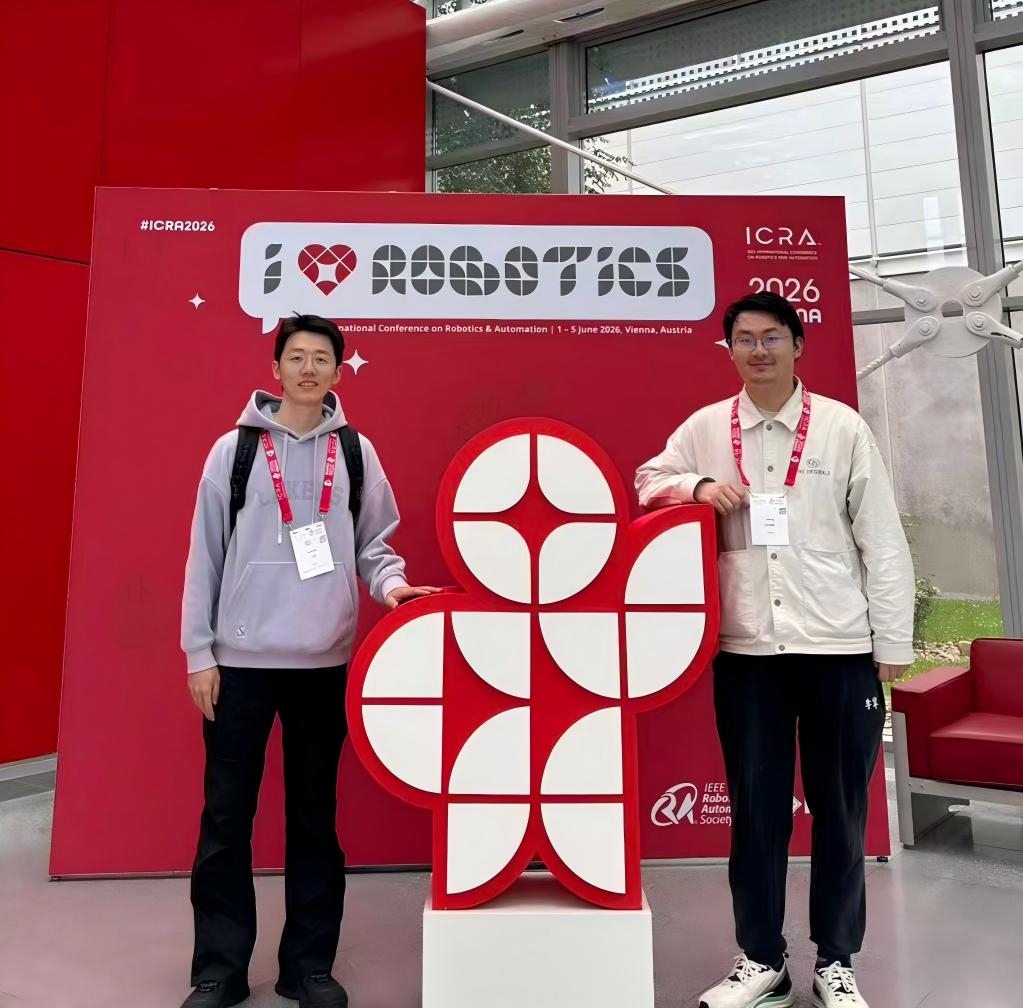
Congratulations to MAgIC Lab for the paper accepted by ICRA2026.

The paper entitled 'Agile and Controllable Omnidirectional Fast-start Maneuvers of Robotic Fish via Bio-inspired Reinforcement Learning' has been accepted for publication in IEEE ICRA. This paper presents a deep reinforcement learning framework for multi-joint robotic fish to reproduce biologically inspired C-start fast-start maneuvers under highly unsteady fluid dynamics. By embedding key biological features into the learning design and training in a high-fidelity CFD environment, the method enables robotic fish to autonomously discover effective launch strategies and achieve controllable high-acceleration motions with improved speed and maneuverability.

ICRA

31 Jan 2026

Congratulations to MAgIC Lab for the paper accepted by ICRA2026.

The paper entitled 'Deep Photonic Reservoir Computing for Ultra-Fast Feedforward Dynamic Compensation of UAVs in Confined Environments' has been accepted for publication in IEEE ICRA. This paper presents an ultra-fast deep photonic reservoir computer (PRC)-based feedforward compensation framework to mitigate nonlinear, time-varying proximity-induced residual forces (e.g., ground/ceiling effects and wake recirculation) that degrade UAV tracking in narrow, cluttered spaces, achieving millisecond-level training via linear ridge regression and ultra-low-latency inference while improving closed-loop stability under high-fidelity CFD evaluations.

Outstanding Students honor

02 Dec 2025

Congratulations to MAgIC Lab Graduate Students Qinxiao Ma and Chenyang Ji on their "Outstanding Students" honor!

The 2025 Graduate Outstanding Student selection results of the School of Information have recently been announced. Qinxiao Ma and Chenyang Ji, graduate students from MAgIC Lab, have been awarded the title of "Outstanding Students" for their excellent academic performance, remarkable research achievements, and active contributions to academic activities. This recognition not only affirms the two students' comprehensive capabilities but also reflects MAgIC Lab's achievements in talent cultivation and academic practice.

Honorable Mention

25 Nov 2025

Congratulations for the paper received an Honorable Mention in this year's Technical Papers program of SIGGRAPH Asia 2025!

We are thrilled to share that a joint research paper, 'A Highly-Efficient Hybrid Simulation System for Flight Controller Design and Evaluation of Unmanned Aerial Vehicles', has been selected by the Best Paper Award Committee to receive an Honorable Mention in the Technical Papers program at SIGGRAPH Asia 2025 — one of the world's premier conferences for computer graphics and interactive technologies. The paper is led by Jiwei Wang, a member of Flare Lab, and co-developed in collaboration with MAgIC Lab. This recognition highlights the work's innovative contributions to drone flight controller development.